


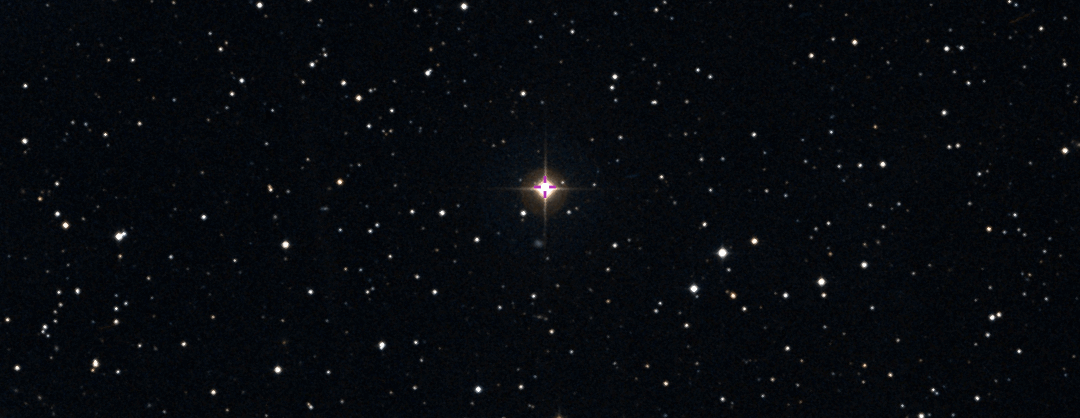
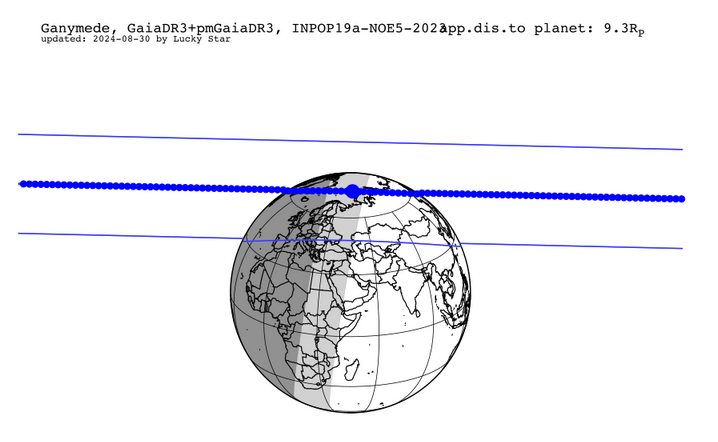
Le 14 octobre 2025, un évènement exceptionnel sera observable pour les astronomes d’Europe occidental, Ganymède, 3ème satellite de Jupiter, occultera une étoile de magnitude 7,5 (HIP 37442) provoquant une légère baisse de luminosité de 0,1 magnitude pendant 17 minutes.
Cette occultation motive une campagne visant à atteindre trois objectifs.
Les collaborations amateurs et professionnels sur les occultations stellaires par les corps du système solaire constituent un domaine très actif en astronomie.
Cet événement semble facilement observable et constitue une belle opportunité pour des débutants de rejoindre la communauté des observations d’occultations.
Cette campagne en plus de mobiliser une large communauté d’amateurs permet de :
– Contraindre la position de Ganymède à quelques kilomètres pour en affiner les éphémérides et préparer les missions Juice (ESA) et Europe Clipper (NASA). Cela pourrait permettre aux deux missions des économies de propergol et de voir ainsi leur durée prolongée.
– Obtenir une position de haute précision de Ganymède (impliqué dans une résonance orbitale de moyen mouvement avec Io et Europe), il sera possible de contraindre davantage la physique du système Jovien.
– Grâce au mouvement angulaire de Ganymède inférieur à 1,4 mas/s, un enregistrement à 100 images par seconde nous permettra d’échantillonner l’étoile par pas de 0,014 mas. Toute fréquence d’images supérieure améliorera l’échantillonnage de la surface de l’étoile.
En France pour rejoindre le réseau des observateurs d’occultations, inscrivez-vous aux ROADIES.
En Europe le réseau IOTA-ES est mobilisé.
L’article en Anglais appelant à participer à cette campagne est disponible dans le « Journal for Occultation of Astronomy » – (JOA 2025-3)
Vous y trouverez le protocole d’observation à suivre et les détails de l’évènement.
Contacts Professionnels (Observatoire de Paris) :
Valery Lainey
Josselin Desmars
Miguel Montargès
Anthony Berdeu
Contacts amateurs (Société Astronomique de France) :
Thierry Midavaine
Arnaud Leroy
Stéphane Neveu



Kick off meeting for observation campaign / Préparation de la campagne d’observation.
T. Midavaine, V. Lainey, J. Desmars, A Leroy
Here are a proposed steps to tune your camera in the nights before the event and before the event !
update Sharpcap to get lattest version Sharpcap 4.1
update the Software from the camera manufacturer
On Sharpcap choose the 16bit output. And keep in mind the maximum native digital dynamic of the CMOS array could be 12, 14 or 16bit. (Do not tick the 8 bit option) and without binning
Define a mid size ROI around 1024×768
As a first step choose an exposure of 5ms
Find the maximum frame rate you may reach in boosting the USB trafic and without frame dropping (its rely on your bus, PC and HDD rates)
Tune the exposure a little less than 1/ fps you reach to have the maximum exposure with this maximum fps.
Are you able to enlarge the ROI in keeping the frame rate ? Yes use this enlarge ROI no try to reduce the ROI to try to reach an fps close to 100fps.
Perform a first tuning of gain around 200 and tune the offset with the histogram monitoring to get the complete gaussian background noise above 0
On the sky, with your camera on the telescope looking at Jupiter and Ganymede
Check the equatorial mount to allow to keep the target in your FOV for one hour at least
Record a 2 minutes long sequence
Then check on Tangra the file to get the Ganymede peak level. You have to reach a level around 50% the affective saturating level provide by the camera (16bit 32000, 14bit 8000, 12bit 2000). If you are far from this level tune the camera gain (Remind the gain is quoted in 0,1dB unit it is a logarithmic scale not a linear one). Therefore you may need iteration between Sharpcap and Tangra to tune the right gain.
With this final fixed gain, check the offset allowing the gaussian background noise to be above 0
Tick the recording of the datum on Sharpcap (ref to Arnaud Leroy presentation on the alternates : Meinberg, Timebox,…)
Before the event put the cap on the telescope to record a dark file (same exposure, fps, gain and offset)
Then run the 2mn recording starting 1min the targeted immersion and emersion for your location.
Gathered all the requested data to deliver your report
Save a copy of your files on Hard Disk
Reminders
Do not saturate the pixels !
Make darks
Keep the target (Ganymede) away from the edge of the imaging field to allow its extraction with a minimum safety distance
Make sure the target remain in the field of view for the entire duration of the acquisition
Do not work in 8 bits mode
Do not 0 – clip